One of the strange small pleasures of living near Sirmione is realising, slowly, that almost everyone who has ever lived here has done the same thing you do on a quiet afternoon — walked to the headland, looked at the water, and got into it. Catullus did. Wealthy Romans built private bath houses into the limestone above the lake. Medieval pilgrims passed through. Nineteenth-century engineers ran pipes from an underwater spring to the first modern hotel. And every winter weekend in 2026, a small queue still forms outside Aquaria for the day pass. Two thousand years of bathing, on the same peninsula, in essentially the same water.
Catullus and his peninsula
Gaius Valerius Catullus, born around 84 BC in Verona and dead by his early thirties, owned a villa on the tip of Sirmione that he loved to the point of embarrassment. His most quoted poem about the place — Carmen 31, addressed directly to the peninsula — opens with a line every Italian school child still half-remembers:
Paeninsularum, Sirmio, insularumque
ocelle, quascumque in liquentibus stagnis
marique vasto fert uterque Neptunus..."Sirmio, jewel of all peninsulas and islands, of all that either Neptune carries on still lakes or on the wide sea..."
What's striking about the poem isn't its rhetoric — Catullus had a habit of overdoing things — but how recognisable the setting still is. Same headland, same shape of bay, same combination of lake light and limestone. He describes coming home, dropping his travelling cares, throwing himself onto a familiar bed, and laughing with relief. Anyone who has come back to a holiday house at the end of a long autumn drive will know the feeling. The poem is two thousand years old and reads as if it were written yesterday.
The Roman bath complex
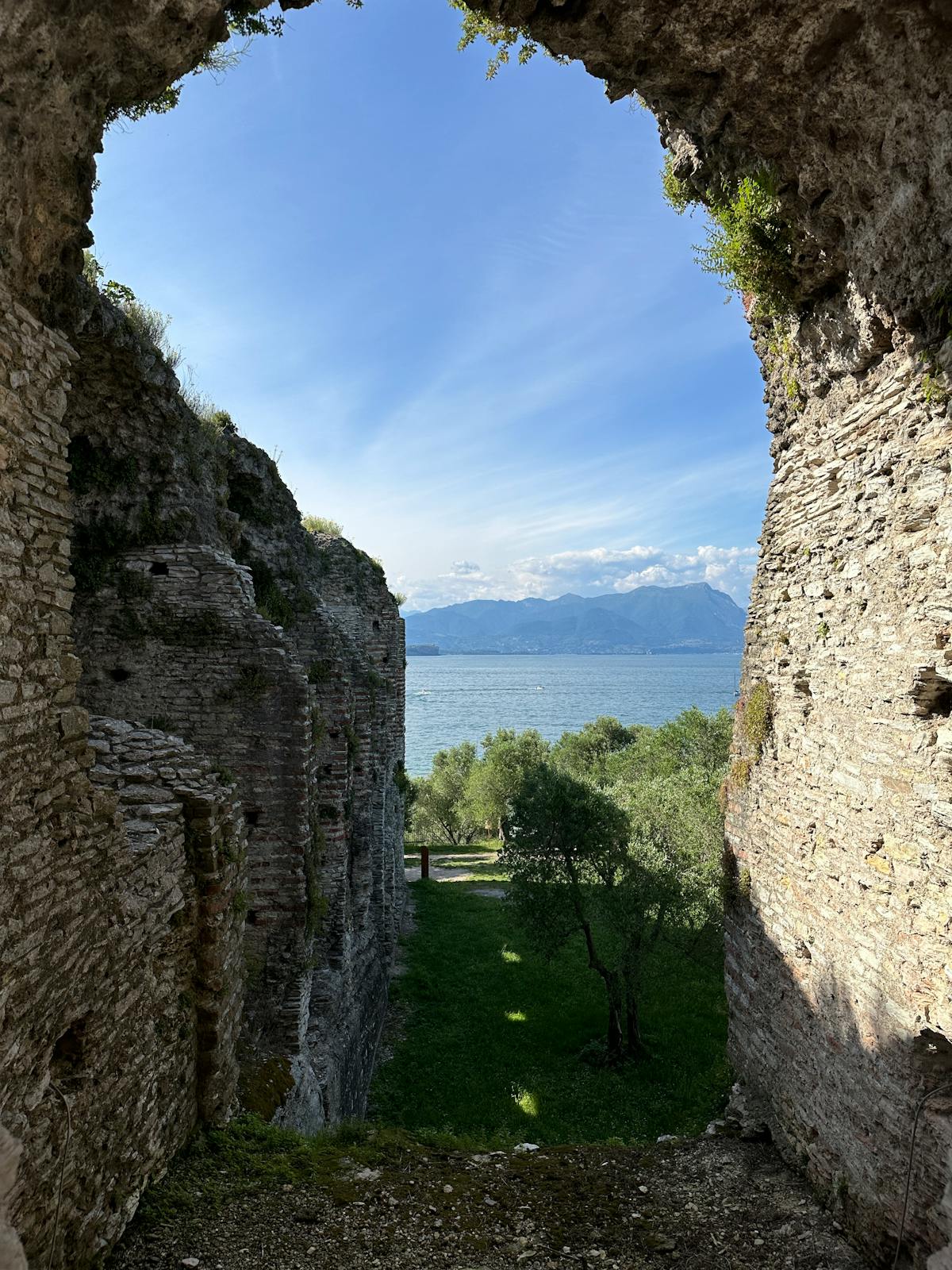
At the very tip of the peninsula, where Catullus's villa probably stood, sits an enormous archaeological park called Le Grotte di Catullo — the Catullus Grottoes. The name is misleading. It isn't a cave system. It's the surviving foundations and partial vaulting of a vast Roman residential complex built between the late first century BC and the first century AD, well after Catullus himself was dead. Whoever built it was extremely wealthy and almost certainly wasn't the poet.
What makes the site relevant to the bathing story is that the complex includes a clearly identifiable balneum — a private bath house — with the standard Roman sequence of cold, warm, and hot rooms (frigidarium, tepidarium, caldarium). The caldarium would have been heated by a hypocaust system, with hot air circulating beneath the floor. There's no archaeological evidence that the Romans piped water from the underwater Boiola spring directly into the bath; the technology to do so wouldn't have been straightforward. But the proximity is striking, and Roman literary references to medicinal warm waters at "Sermione" suggest they knew the spring was there even if they didn't tap it.
You can still walk through the foundations today. Some of the rooms preserve fragments of original mosaic flooring; one section of vaulted cellar is intact enough to feel like a real space rather than a footprint. The whole site sits on a rise looking south across the lake, and on a clear winter morning the view is essentially unchanged from what Catullus would have known.
A long medieval pause
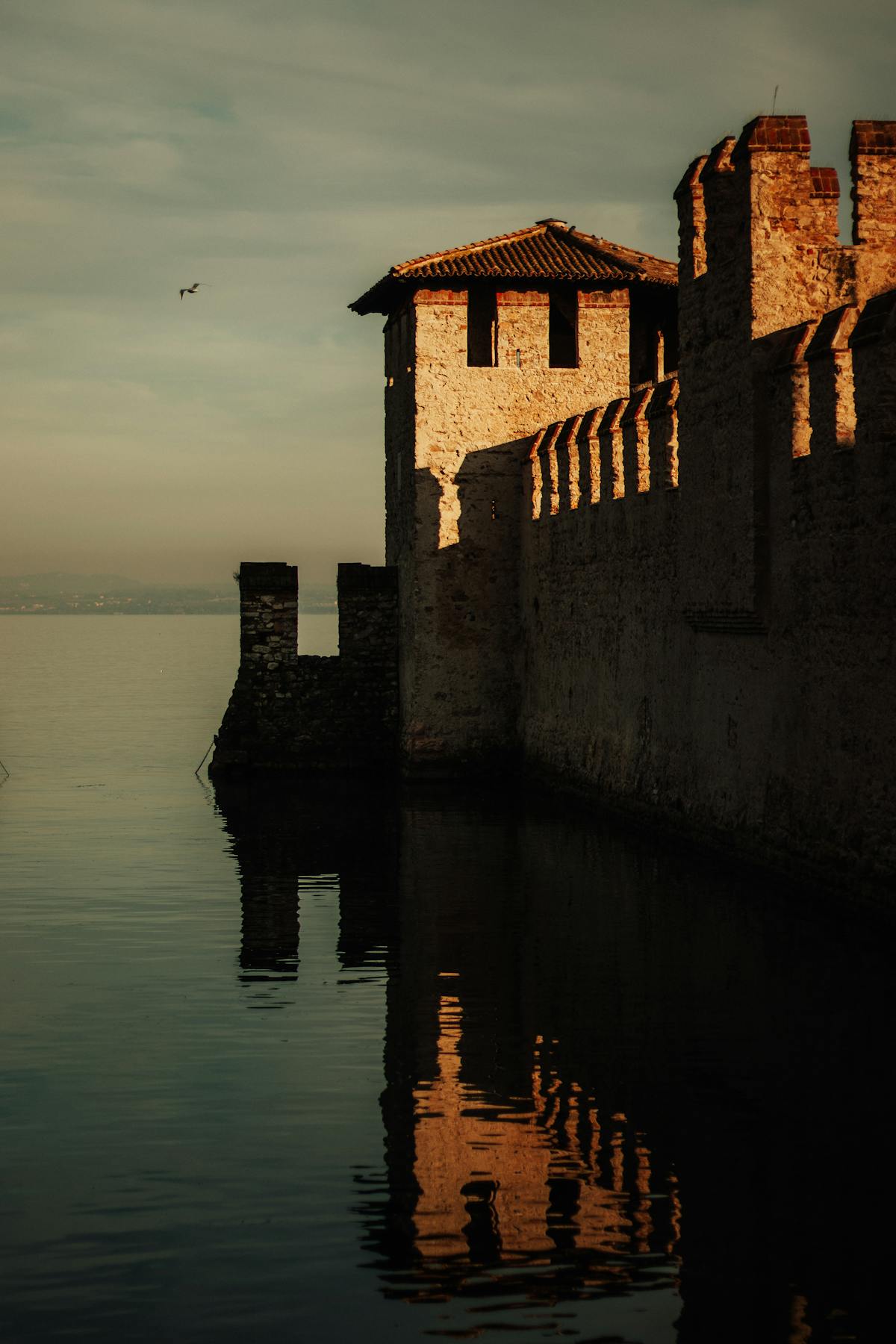
Between the fall of Rome and the late 1800s, Sirmione's bathing tradition went mostly underground. Medieval Sirmione was a small fortified village protecting a strategic point at the southern entrance to Lake Garda. Mastino I della Scala — head of the Verona-based Scaliger family — built the Castello Scaligero between roughly 1259 and 1277 to control the harbour and the peninsula approach. Today's lakefront castle, with its swallowtail merlons and its small fortified port, is essentially his.
Through this period nobody seems to have done much organised bathing. The Boiola spring kept rising, no doubt warming a small patch of lake all winter, but there's no record of a medieval thermal facility. Pilgrims and travellers passed through Sirmione on the route from Verona to Brescia and noted its beauty, but the spa tradition had genuinely lapsed.
Stefano Spreafico and 1889
Modern Sirmione's thermal era began with a single underwater survey. Stefano Spreafico, a Milanese industrialist who had been studying classical references to medicinal hot waters in northern Italy, suspected — correctly — that the Roman descriptions of warm springs at Sirmione referred to a real, still-active geological feature. In 1889 he commissioned a survey of the lakebed off the peninsula and dropped weighted thermometers at points around it. One came back at sixty-eight degrees Celsius. By the early 1890s a feasibility study was complete; by the early 1900s a pipe ran from the spring to the first modern thermal facility on the headland.
What Spreafico had effectively done was bridge two thousand years. The Roman literary references he was reading turned out to be describing the same geological source the Aquaria pump now feeds. There's something quietly remarkable about that — the long underground patience of a hot spring, bubbling up under the lake every minute of every century, mostly unnoticed, until someone with the right combination of curiosity and capital decides to find it again.
The twentieth-century build-out
Once the spring was tapped, things moved quickly. Hotel Terme di Sirmione opened in the early 1900s as a residential thermal cure facility, drawing the Italian and central European bathing public who already knew Karlsbad and Vichy and were ready for an Italian alternative. By the interwar period it had become one of the established Italian spa hotels.
Aquaria, the modern leisure-spa centre, came much later — 1997, with a major refurbishment around two decades on. Where Hotel Terme di Sirmione is medical and clinical, Aquaria was built explicitly for the contemporary wellness market: day passes, sauna circuits, infinity pools, the salt grotto. Same water; very different building.
| Era | Structure | Visible today |
|---|---|---|
| 1st c. BC | Catullus's villa (probable) | No clear remains |
| 1st c. AD | Roman residential complex with balneum | Yes — Grotte di Catullo |
| 13th c. | Castello Scaligero | Yes — main castle and port |
| 1889 | Spreafico's survey of underwater spring | No — survey only |
| Early 1900s | Hotel Terme di Sirmione (Catullo) | Yes — still operating |
| 1997 | Aquaria Thermal SPA | Yes — refurbished, still operating |
Italian termalismo today
Sirmione belongs to a wider Italian tradition known as termalismo: a national network of around three hundred officially recognised thermal centres where treatments are partly reimbursed by the state health service for specific medical indications. Italy is unusual in Europe for the scale of this infrastructure — Germany has its Bäder, France its thermes, but the Italian system is built into the public health timetable in a way that lets a GP in Brescia write a prescription for a thermal cure as casually as for physiotherapy.
That tradition is still alive at Terme di Catullo on Sirmione. On a Tuesday morning in November you can watch a queue of pensioners moving through the inhalation rooms with the bored efficiency of regulars at any clinic. They are not on holiday. They are doing what their grandparents and great-grandparents did a century ago, in essentially the same building.
Visiting the Roman ruins
Of all the historical layers in this piece, the Roman one is the most directly visitable. Grotte di Catullo is run as an archaeological park by the regional cultural authorities and sits at the very tip of the peninsula, a fifteen-minute walk from the old town centre.
Practical detail
The Grotte di Catullo archaeological site is open Tuesday to Sunday, closed Mondays and on a few national holidays. Hours run roughly 8:30 to 17:00 in winter, 8:30 to 19:00 in summer. Standard adult entry is around eight euros, with reductions for under-25s and an EU-resident free day on the first Sunday of each month. There's a small site museum at the entrance with finds from the excavation. Allow ninety minutes for a slow walk through the foundations and another thirty for the museum.
The official site for the archaeological park sits at museilombardia.cultura.gov.it (the regional ministry of culture); for an English-language summary of the site's history, Britannica's Catullus entry is a useful starting point, and Italy Magazine has run features on the broader thermal tradition that fill in the contemporary picture.
Walk through the Roman foundations in the morning. Have a coffee in the old town. Book the afternoon slot at Aquaria. By the time you slide into the thermal pool with the lake outside the window, you'll know that the water rising under your shoulders has been doing exactly this — heating, surfacing, being noticed by humans, being put to use — for at least two millennia. It's a quietly stabilising thought.
For more on where exactly the spring rises, see the Boiola entry. For the practical comparison of today's two thermal centres, the Aquaria-versus-Catullo guide is where I'd send you next. And the old town walk covers the route from the drawbridge to the Grottoes themselves.